Why a ban will not protect us from the dangers of social media

Why a ban will not protect us from the dangers of social media 

As yet another politician extols the merits of banning social media for those under 16 in the name of online safety, many of us working in children’s rights find ourselves dismayed by the persistence of such quick-fix, headline-grabbing proposals. These measures, while superficially appealing, shift responsibility onto parents and children, rather than addressing the role of the technology companies whose platforms underpin much of the harm. 

On Sunday, June 14th, more than 140 children’s rights organisations across Europe, including the ISPCC, co-signed an evidence-based letter to the European Commission making clear that it is neither fair nor effective to require children to bear the cost of rectifying problems that are fundamentally embedded in the design and business models of online services. 

A blanket ban risks entrenching harm by diverting attention away from where meaningful accountability should lie. Instead, we should be insisting on a strict “safety by design” standard, supported by privacy-preserving and robust age assurance mechanisms. This approach places responsibility on platforms to create safer environments from the outset. 

Efforts to improve online safety must not come at the expense of children’s rights — including their rights to information, education, participation and play. A crude age-based prohibition would not only fail to eliminate harm but would likely displace it, pushing young people towards less regulated or entirely unregulated spaces where risks may be even greater. 

Furthermore, such bans risk diminishing the urgency to address the systemic issues that drive harm online. These include behavioural profiling, addictive and manipulative design features, recommender systems that amplify harmful content and commercial practices that exploit children’s data and vulnerabilities.  

A more constructive response must recognise that responsibility is shared. Parents, platforms and young people all have a role to play.  

Many of the risks children face online stem from the design of the platform. Features that prioritise engagement over wellbeing can expose young users to manipulation, exploitation and grooming — often in ways that are difficult to detect. Children who do not recognise such harms are unlikely to report them. 

It is essential that young people learn to question what they see online, to understand how algorithms shape their experience and to trust their instincts when something feels wrong. The impact of harmful online content inevitably spills into children’s offline lives, affecting their wellbeing. 

At the ISPCC, our priority is to empower young people with the resilience and coping skills they need to thrive in an increasingly complex digital world.  

Our Childline Listening Service operates 24 hours a day, every day of the year, ensuring that any young person who needs to talk will always find someone ready to listen. 

Say Thank You to a Teacher – and Support Childline

Say Thank You to a Teacher – and Support Childline

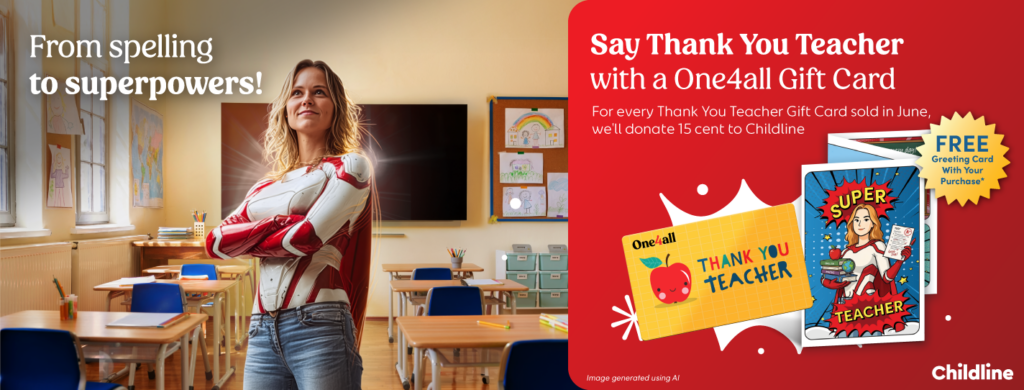
This June, every purchase of a One4all Thank You Teacher Gift Card helps support Childline’s vital services for children and young people across Ireland.

For every Thank You Teacher Gift Card sold in-store or online throughout June, One4all will donate 15 cent to Childline by ISPCC. It’s a simple way to recognise the incredible work of teachers and SNAs while making a difference for children who need support.

Whether you’re thanking a teacher who inspired confidence, encouraged learning, or simply made a difference throughout the school year, your gift will also help Childline continue to be there for every child who reaches out for support.

Purchase your gift card here: