ISPCC delighted to see one of its key recommendations included in the report by the Committee on Education, Further and Higher Education, Research, Innovation and Science on Mental Health Supports in Schools and Tertiary Education

ISPCC delighted to see one of its key recommendations included in the report by the Committee on Education, Further and Higher Education, Research, Innovation and Science on Mental Health Supports in Schools and Tertiary Education

ISPCC welcomes the publication of the Committee on Education, Further and Higher Education, Research, Innovation and Science’s report on Mental Health Supports in Schools and Tertiary Education.

We are pleased to see the Committee take on a recommendation from ISPCC that the youth mental health pathfinder project be commenced without further delay. ISPCC was a member of the Youth Mental Health Taskforce where this recommendation was originally mooted back in 2017. 

“We firmly believe that if we are to solve the crisis of our child and adolescent mental health service, the initiation of this unit is crucial. This week has seen the harrowing state of CAMHS being brought into focus in the interim report of the Mental Health Commission,” says CEO John Church. “The UN Committee on the Rights of the Child in its State examination of Ireland struggled to understand how we have such long waiting lists for these services.”

The initiation of the unit would address the relevant gaps and challenges in this cross-cutting area, ultimately improving whole of government approach. 

Furthermore, we believe that it’s essential that mental health be a core focus of the next national policy framework for children and young people, with funding ring-fenced for both universal and targeted services. 

It is fantastic to see the Education Committee recommend that ring-fenced funding be made available to non-statutory mental health supports for students to address the overflow of demand on the statutory services and to reduce waiting times. ISPCC provides many services already that could support Government to meet such a demand.

We are grateful that our Childline service was recognised by Mr Justice Clarence Nelson at the UN Committee on the Rights of the Child in Geneva at Ireland’s State examination. We are here for all children and they can reach out for any reason.

ISPCC has supported children, young people and families since its inception in 1956 and next month it will be 35 years since its flagship service, Childline, began. Since then, Childline has developed with the times and now offers a suite of multi-channel services delivered both face-to-face and non-face-to-face, responding to the needs of children and young people. 

We are delighted to see that the Committee recommends that wellbeing supports be an integral part of the curriculum and that there be mandatory training on many areas including bullying.  This is a key policy area for ISPCC and we developed our Shield Anti-Bullying programme as a direct response to the issue of bullying and how it was impacting the mental and emotional health and wellbeing of children. 

We were delighted to collaborate with DCU’s Anti-Bullying Centre and our Irish Safer Internet Centre partners Webwise on the Shield programme

For real reform in the area of child and youth mental health, it is imperative that we understand the issues at play, that all relevant stakeholders work together and that the requisite resources are put in place. 


Notes to Editors:

ISPCC Head of Policy and Public Affairs Fiona Jennings is available for comment or interview. 

For more information, please contact Rowena Walsh, ISPCC Marketing and Communications Coordinator. Tel: 087 3157552 

Email: [email protected]

About ISPCC

ISPCC is a national charity dedicated to enhancing the lives of children and young people; they are at the heart of everything we do.  We provide the Childline suite of services. 

Our child-centred services, programmes and supports are focused on strengthening resilience and developing coping competencies.  

 Any child or young person in Ireland up to and including those aged 18 years of age can contact Childline’s 24-hour support line by live chat – Childline.ie or calling 1800 66 66 66.

Our 24/7 Childline listening support service involves professionally trained facilitators actively listening, supporting and empowering children and young people. Our Childline Therapeutic Support Services offers children and young people a more long-term, personalised individual plan of support depending on their level of need and presenting issues. 

ISPCC’s Digital Mental Health and Wellbeing programmes aim to reduce anxiety for children and young people, as well as helping their parents/carers to manage their own anxiety while supporting their anxious child or teenager. These CBT-based programmes have been developed by SilverCloud, a leading digital mental health provider.

Smart Moves is our evidence-based resilience programme specifically focused on the transition from primary school to post-primary school. Best practice tells us that students need to be supported not just before they transition from primary school to post-primary school, but also during and after.

ISPCC response to the release of the interim report by the Mental Health Commission into the Child and Adolescent Mental Health Service (CAMHS)

ISPCC response to the release of the interim report by the Mental Health Commission into the Child and Adolescent Mental Health Service (CAMHS)

ISPCC shares the sense of shock felt by many on the publication of the interim report by the Mental Health Commission into the Child and Adolescent Mental Health Service (CAMHS). 

The finding that CAMHS has left more than 100 children without care for up to two years is, as Tánaiste Micheál Martin says, ‘unacceptable’. 

In light of these findings, it is timely that Minister O’Gorman and his officials will be examined by the UN Committee on the Rights of the Child in Geneva tomorrow and Wednesday. Mental health will be a key focus there, as it needs to be at home. 

The fact that the Mental Health Commission felt compelled to publish an interim report on CAMHS is illustrative of the crisis facing the service. Yet, sadly, this is not a surprise for those of us working to support children and young people. 

For many parents/carers, it comes as a relief when their child is receiving support from CAMHS. “However, we read that some of these children are ‘lost children’ within the system,” says Fiona Jennings, ISPCC Head of Policy and Public Affairs. 

“It is truly frightening that children who have been on medication are not receiving ongoing assessments to ascertain the impact of such medication on their mental health and behaviour. In such circumstances, how can it be judged whether these interventions are making a meaningful and positive difference to the mental health of the child or young person?” 

The ability of CAMHS to provide a meaningful service is also hampered by staffing issues and the slow pace of digital transformation. A digital system that allows for timely monitoring and continuity of care is essential. As it stands, the system is utterly broken, despite the best efforts of those working within it. 

While we will always need CAMHS, it needs to be considered what can actually be done with the service in the short term to alleviate this current crisis, and we strongly suggest that there is a rethink of the CAMHS service delivery model; children and young people ought to be able to avail of such a service when and where they need it.  

At ISPCC, mental health concerns are one of the primary reasons why children and young people contact us. Calls on mental and emotional health was a top profile in our 24/7 Childline Listening Service over the Christmas period. 

Children have a right to appropriate care, and at ISPCC we know the importance of prevention and early intervention. 

We call on the Government to commit to a policy of both targeted and universal investment in mental health service provision. It needs to be a core focus in the next national children’s strategy. 

ISPCC reiterates its call for the Government to commit with haste to the implementation of the Pathfinder interdepartmental unit on youth mental health in order to align and streamline the mental health supports across various government departments. 

Notes to Editors:

ISPCC Head of Policy and Public Affairs Fiona Jennings is available for comment or interview. 


For more information, please contact Rowena Walsh, ISPCC Marketing and Communications Coordinator. Tel: 087 3157552 

Email: [email protected]


About ISPCC

ISPCC is a charity dedicated to enhancing the lives of children and young people.

The charity provides a suite of Childline services and supports for children and young people up to and including those aged 18 years of age.  Childline’s 24-hour support line can be contacted for FREE, 365 days a year 24/7.  Children can chat online at childline.ie or call 1800 66 66 66.

ISPCC provide services, supports and programmes for parents/carers and those working or volunteering in child and youth settings e.g. schools, clubs, crèches etc.

Our CBT-based programmes by Silvercloud, a leading digital mental health provider, Supporting an Anxious Child and Supporting an Anxious Teen provide essential support for parents/carers and teens experiencing anxiety. 


ISPCC responds to concerning insights from Hotline.ie’s annual report for 2021

ISPCC responds to concerning insights from Hotline.ie’s annual report for 2021

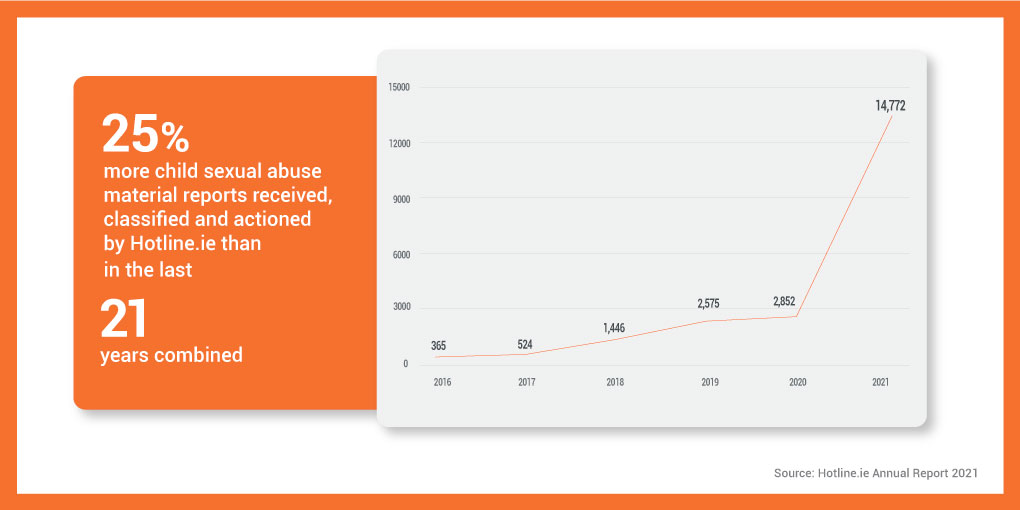
Hotline.ie’s 2021 ‘People Not Pixels’ annual report highlights how the team has classified and removed 25% more child sexual abuse material online this year than in the previous 21 years combined. 

The prevalence of this type of material online can be retraumatising for the children depicted in the material as it is shared and reshared online, along with the real-world harm caused to them. Such material can also be distressing for those who are exposed to it, unwillingly.

ISPCC is particularly concerned with the finding that one in four of the child sexual abuse material online reports appeared to have been generated by children themselves. Hotline.ie states that within these reports there were signs of grooming behaviour by adults in the form of instructions and threats. 

Fiona Jennings, Senior Policy and Public Affairs Manager said: “We commend the dedicated and committed team at Hotline.ie for their stellar efforts in carrying out this important work. The findings from their ‘People Not Pixels’ annual report ought to get the attention and warranted action from legislators. All agencies working to identify and support victims and to identify perpetrators, along with law enforcement, must be resourced accordingly to carry out this vital work.”

ISPCC is proud to partner with Hotline.ie along with Webwise and the National Parents Council Primary in the Irish Safer Internet Centre, each bringing their individual expertise to the table in trying to combat this abuse and exploitation online and support all those who are affected by it. 

Fiona Jennings continued: “As a society, we must do better to work with everyone affected by child sexual abuse online. Education is crucial but it must not be left solely to children to stop this abuse. We all have a role to play and must stand together against such abhorrent crimes. 

We know from the children who get in touch with Childline that they can often be confused and indeed unaware of the harm being caused to them. There must be no place for ambiguity – these are real children with real abuse and harm being caused to them, with real trauma and physical and psychological impacts. These crimes are not victimless.”

ISPCC reiterates its call for a national strategy on child sexual abuse as per the recommendation of the Garda Inspectorate if we are to meaningfully tackle this problem.

ENDS 

Notes to Editors:

ISPCC Senior Policy and Public Affairs Manager Fiona Jennings is available for comment or interview. 

For more information

please contact Rowena Walsh, ISPCC Marketing and Communications Coordinator. Tel: 087 3157552 

Email: [email protected]

About ISPCC

ISPCC is a charity dedicated to enhancing the lives of children and young people.

The charity provides a suite of Childline services and supports for children and young people up to and including those aged 18 years of age.  

All services and supports champion prevention and early intervention, focusing on strengthening resilience and developing coping skills that will last a lifetime.

Childline’s 24-hour support line can be contacted for FREE, 365 days a year 24/7.  Children can chat online at childline.ie or call 1800 66 66 66.

ISPCC provide services, supports and programmes for parents/carers and those working or volunteering in child and youth settings, for example schools, clubs, crèches etc.

Through its policy and public affairs work, ISPCC advocates for meaningful change for children and young people now and leaves a legacy of improved experiences for future generations. 


ISPCC welcomes the signing into law of the Online Safety and Media Regulation Act

glossary
glossary

ISPCC welcomes the signing into law of the Online Safety and Media Regulation Act

On Saturday, December 10, President of Ireland Michael D. Higgins signed the Online Safety and Media Regulation (OSMR) Act into law. 

ISPCC welcomes the signing into law of this important act and thanks public representatives and stakeholders for their sustained engagement to better understand why such legislation was needed. 

John Church, ISPCC Chief Executive said: “This act is a crucial piece of work designed to improve the safety and experience of children and young people in the ever-evolving digital environment. At ISPCC, we believe that the signing into law of this act represents a hugely positive day for children and young people in terms of the online products and services they use.”

Prior to the genesis of this extremely important act, ISPCC had become increasingly concerned about the lack of attention being paid on a governmental level to the safety of children and young people when online. In particular the harmful content they were increasingly being exposed to and the harmful conduct they were expected to deal with – often alone with minimal support from hosting platforms. 

ISPCC was grateful to have the opportunity to share these concerns to the then Committee on Children and Youth Affairs when it began to examine this complex issue. 

In particular, ISPCC commends Minister Martin for taking on the expert panel’s view of the feasibility of an individual complaints mechanism in the act and bringing forward an amendment to provide for this vital online child protection measure. ISPCC was steadfast that failing to provide for such a provision would be leaving our children alone to deal with big platforms to get cyberbullying content removed. 

John Church continued: “We know first-hand through our suite of Childline services the impact such harmful behaviour online can have on those who are targeted in this manner. It is all our responsibility as adults to ensure that there is a safe digital environment for children and young people. They deserve nothing less than this.”

ISPCC has advocated strongly for the inclusion of both an individual complains mechanism and an Online Safety Commissioner and will continue working to ensure that children and young people can avail of the opportunities the digital environment offers in a safe and meaningful way. 

However, there is still much to do. We need an updated action plan on online safety, the Online Safety Commissioner must be sufficiently resourced and proposed binding codes must be fit for purpose. 

ISPCC has worked on this issue for many years and appreciates the complexity and nuances of the policy responses required. We would also like to acknowledge the legal support we received from the Public Interest Law Alliance (PILA) and in particular Eithne Reid O’Doherty BL. The signing into law of this Act shows that when children talk to us and tell us about their issues, we act accordingly to bring about meaningful change for them.

ENDS

Notes to Editors:

ISPCC Senior Policy and Public Affairs Manager Fiona Jennings is available for comment or interview. 

For more information please contact Rowena Walsh, ISPCC Marketing and Communications Coordinator. Tel: 087 3157552 

Email: [email protected]

About ISPCC

ISPCC is a charity dedicated to enhancing the lives of children and young people.

The charity provides a suite of Childline services and supports for children and young people up to and including those aged 18 years of age.  

All services and supports champion prevention and early intervention, focusing on strengthening resilience and developing coping skills that will last a lifetime.

Childline’s 24-hour support line can be contacted for FREE, 365 days a year 24/7.  Children can chat online at childline.ie or call 1800 66 66 66.

ISPCC provide services, supports and programmes for parents/carers and those working or volunteering in child and youth settings, for example schools, clubs, crèches etc.

Through its policy and public affairs work, ISPCC advocates for meaningful change for children and young people now and leaves a legacy of improved experiences for future generations.