
ISPCC offers FREE online mindfulness workshops for children and teens

Join us online on January 16th to explore how mindfulness can make a positive difference to children and young people. ISPCC is offering three free workshops for primary and post primary school students. 

Each of the three sessions are interactive, directed at the relevant developmental stage of the attendees and designed to be engaging and playful in nature. They last 30-40 minutes and will be presented by Victoria Howson who is ISPCC’s Shield Anti-Bullying Programme’s Community Engagement Manager as well as a trainee Educational Psychologist with the HSE.

The first workshop at 9.30am is dedicated to exploring how mindfulness can help teens navigate academic pressure, social dynamics and emotional challenges. Through guided practice, relatable examples and reflective discussions, students will discover concrete strategies for focus, calm and self-awareness that they can seamlessly incorporate into their daily lives. 

The second session at 11am is aimed at pupils in junior infants, senior infants, first and second classes and it will introduce them to mindfulness through simple stories, movement and sensory exploration. They will learn age-appropriate techniques to help deal with overwhelming feelings.  

The third workshop at 11.55am is aimed at those in third to sixth classes and through interactive activities, guided breathing and reflective exercises, attendees learn how mindfulness can support focus, emotional balance and everyday wellbeing.  They will gain concrete strategies that are applicable both at school and at home. 

The aim of these sessions is to introduce children and teens to key tools and thought process that they can utilise to reduce anxiety, navigate emotional challenges and deal with pressure. It is also to encourage participants to make the best of every day they have and to understand that it’s okay to have feelings, even uncomfortable ones, they don’t have to be ignored. 

Teachers will need to provide a screen and speakers for the workshops.  

To learn more about the workshops and to register, go to ISPCC Webinars – ISPCC

Behind the closed doors of homes across Ireland, many children suffered in silence this Christmas* – but Childline was there for them

Behind the closed doors of homes across Ireland, many children suffered in silence this Christmas – but Childline was there for them

“It’s such a hard time of year to feel so alone, I haven’t spoken to anyone today, I wish things were different, like it is in the movies, but it’s not. It was brilliant to be able to call Childline, I knew that you would be here for me and it does help a little.”  Emma*, 14. 

Today (December 26th) is set to be one of busiest days of the year for Childline with the team expecting that more than 300 contacts will be made to Ireland’s only 24-hour listening service for children and young people  

Dublin, December 26th, 2025 – Childline reveals that today (St Stephen’s Day, 2025) will be the busiest day of the year for Ireland’s only 24/7 listening service as children come to terms with what they have experienced over the Christmas* period.  The dedicated Childline team is expecting that more than 300 contacts will be made from children and young people across Ireland. 

Heartbreaking data also reveals that over a three-day Christmas period (December 23rd, 24th and 25th) whilst many of us were enjoying gifts, treats, twinkly lights and Santa, Childline received 615 contacts from children who turned to the team because Christmas for them was not a time of joy but one of neglect and misery. Shockingly, seven young people turned to us with suicidal thoughts.

Bullying, abuse, neglect, mental health, substance misuse, strained family relationships and grief are just some of the many reasons children turn to Childline – reasons that sadly are even more pronounced during what is meant to be a magical time of the year.

Additional statistics from Ireland’s only 24/7 listening service for children and young people reveal:   

  •                The Childline team spends the equivalent of 146 full days a year talking to children and young people in immediate crisis
  •                35children and young people a year are in the process of trying to take their own life whilst in contact with the Childline team
  •                Childline receives over 2,300 contacts a year in relation to sexual, physical and emotional abuse
  •                300 children a year contact Childline about sexual abuse involving rape and being forced to watch and/or perform sexual acts    

Over the last five years, there has been a noticeable increase in the number of children engaging with Childline who are at high risk of harm. Sadly, such stark revelations come as no surprise to the dedicated team of staff and volunteers at ISPCC.   

The Childline team know they are an essential support for so many neglected children, and Childline is open 24/7 to any child for any reason at Christmas, as it is throughout the year. 

“Christmas is supposed to be the one day when families spend time together in peace and harmony,” said volunteer Joe Keane. “However, for children who call Childline at Christmas, the holiday can be one of the loneliest and most difficult times of the year. As a volunteer, being there on Christmas Day means I can make sure they feel listened to and heard.”

John Church, CEO, ISPCC said: “For too many children and young people, Christmas simply doesn’t happen. Too many don’t have the Christmas that they dream of and deserve. Instead, a day that should be full of joy is nothing special and sometimes a lot worse. They turn to Childline for support, and our amazing staff and volunteers are there for them 24/7 over Christmas, as they are throughout the year. Without help from public donations, we would simply not be able to be here for every child who needs us.” 

To help Childline continue to be there for children go to ispcc.ie   

*Christmas statistics refer to December 23, December 24 and December 25 

* Contacts refers to all contacts (chats/phones) that dial 1800 66 66 66/connect to LiveChat  

Anxiety levels are rising among exam students and their parents, but ISPCC can help with free webinars

student study
student study

It’s that time of year again… the spectre of the dreaded exams is looming for students and their parents, but ISPCC can help.

Students aren’t the only ones who need support in the run up to exam time, parents do too.

After all, how can you help your anxious child when you’re feeling anxious yourself? It’s only natural for stresses build up as the exams draw closer and it’s a pressurised time for everyone at home.

A parent or carer can’t help their child if they feel ill-equipped to do so and it can be easy for them to feel as if they have failed their child when they see them suffering from anxiety.

ISPCC is offering two free webinars on coping with exam anxiety – the first is specifically for parents and carers, while the second will focus on young people along with their parents and carers.

The two-part series will focus on explaining what anxiety actually is and how it manifests itself, support for dealing with an anxious child, anxiety management tips and tools and Childline’s Digital Mental Health and Wellbeing programmes, which provide free ongoing support for both young people and their parents.

* The first webinar for parents and carers takes place on Monday, May 13, from 7pm to 8pm.

* The second, which is aimed at young people aged 12 years and over as well as their parents and carers, is on Tuesday, May 14, from 7pm to 7.30pm.

They will be hosted by ISPCC parenting lead Siobhan Harvey and Niamh Clarke, Manager of ISPCC Smart Moves programme, while Bree O’Neill who manages Childline’s Digital Mental Health and Wellbeing programmes will be the keynote speaker.

For more information on the webinar for parents and carers, please go to https://bit.ly/44riFL1 

To find out more about the webinar aimed at young people, please go to https://bit.ly/3wqPVFt

Make time for breakfast… rise and shine with Childline by ISPCC this May

Childline calls on the people of Ireland to take time for breakfast and help raise vital funds for Ireland’s only 24hr listening service for children and young people

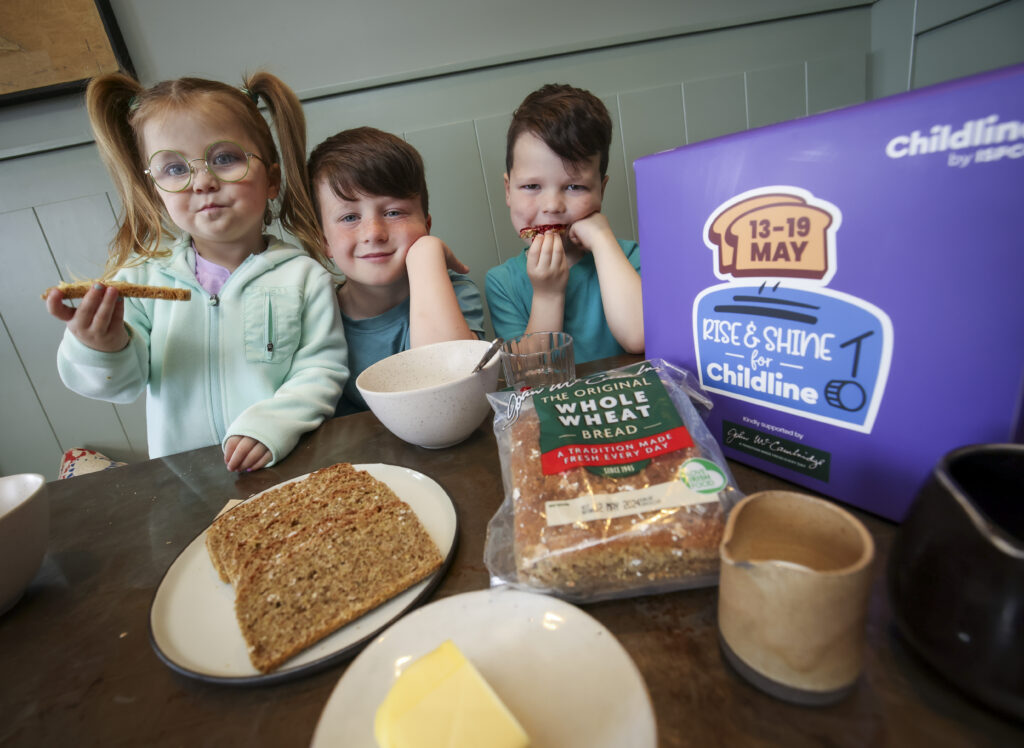
Rise and shine for Childline: Sydney, Brogan and Reggie Power tuck into a tasty breakfast, kindly sponsored by McCambridge’s Bread

We’ve all seen the ads of happy families laughing and chatting over a leisurely breakfast. So far, so unrealistic. In reality, it can be far from the morning routine in most homes across Ireland. But wouldn’t it be nice to carve out a little time at the start of day to have a family chat over your tea and toast without feeling under pressure?

This May, Childline by ISPCC is calling on families, schools, clubs and workplaces throughout the country to take time for breakfast – to sit, listen and enjoy each other’s company while hosting their own breakfast to support Ireland’s only 24/7 listening service for children and teenagers nationwide. 

In recent weeks Childline has seen a dramatic rise in demand for all its services. Since February alone, 145 children have reached out to talk to Childline staff and volunteers about self-harm, and 65 of those are repeat contacts who have then asked for help with suicide ideation.

Children and young people tell ISPCC their concerns through its 24/7 Childline listening service, through its therapeutic services and through its Shield Anti-Bullying programme. 

The benefits of breakfast go far beyond simple nutrition. Eating breakfast together provides a great opportunity to check if your children are anxious or worried about anything about the coming day.

When you sign up to host your own Rise and Shine Breakfast, you will receive your own digital pack that includes conversation starter cards designed by our in-house therapeutic experts at Childline that will help you to encourage check-ins with the children and young people in your life.

Research shows that eating family meals together has been linked to children’s overall wellbeing, improved nutrition and protection against eating disorders. It’s also associated with more physical activity and less screen time.

Childline relies on the generosity of the public to raise 65% of its funding to ensure that there is always someone to listen when a child needs to talk. And you can help Childline to continue to be there 24/7 with your own breakfast gathering. 

To find out more, go to https://childlinebreakfast.com/
So go on, this May rise and shine for Childline!

What is Coco’s law? ISPCC is offering a FREE webinar all about the law around the sharing of intimate images

Coco’s Law was born out of a tragedy and while many people may have heard about the death of Nicole ‘Coco’ Fox, few really understand the law enacted in her name. ISPCC can help. Fiona Jennings, Head of Policy and Public Policy at ISPCC, is leading a webinar explaining all about Coco’s Law on April 30th. It is free to all.

Coco died aged just 21 after relentless online bullying. Her mother Jackie campaigned tirelessly to change the law on the sharing of intimate images, and she succeeded in December 2020 when Harassment, Harmful Communications and Related Offences Bill, known as Coco’s Law, was signed into law.

The online world is constantly evolving and pressure on young people is ever present. The revelation that nearly one in six young teenagers were cyberbullied in 2022, according to the new World Health Organisation Europe report, an increase from 13% just four years ago, comes as little surprise to those at ISPCC who work with children and young people and see the very real impact of cyber-bullying on them.

The ISPCC webinar on Coco’s Law is an information session for parents and professionals and it will focus on the following:
• Awareness of Coco’s Law
• Recognition of the issues that it covers
• Guidance on how to avail of its provisions

Webinar details are: 
April 30, 2024, from 7pm to 7.30pm
To register for the event, please follow this link: https://bit.ly/4aOKNKb

How ISPCC can help children make the leap from ‘big’ school to secondary school

SMART MOVES

Why schools need ISPCC’s Smart Moves programme

Big life changes can be exciting but they’re also daunting and the move from primary school to secondary school can be a tough one. ISPCC can help. Its Smart Moves programme is designed to facilitate this life transition, and it has received rave reviews from users.

Smart Moves is a free, resilience- and evidence-based programme for fifth- and sixth-class pupils. There is also a secondary school programme available, which supports young people as they begin their journey in secondary school.

The primary programme is teacher-led and includes 15 short lessons covering topics from friendship to problem-solving to sleep difficulties. The secondary programme provides a total of 24 lessons, each lasting approximately 30 minutes.

According to one educational professional, “it stimulated good conversations”, while another said that the programme was very easy to use and thought-provoking, adding that “it encouraged pupils to think about potential worries, problems and routes of support”.

“There are many areas covered in the programme that both students and teachers had never considered before as part of the transition that are really important,” said a teacher, who added that “the length of programme is also a hit, we have found in the past that a little work in sixth class at the end of the year is not enough.”

For the students themselves, completing the Smart Moves programme was an overwhelmingly positive experience and they would recommend that other schools get involved in it. One sixth-class pupil said, “it made me feel more prepared by talking about my feelings and other people’s feelings”.

Niamh Clarke of ISPCC says that: “Smart Moves is based on the resilience framework and looks to build lifelong coping skills for young people. Having resilience does not mean you will not face challenges. However, it gives ability to endure these challenges and bounce back.”

The programme’s resources will be sent directly to each school at the start of the 2024/25 academic year: they include a manual for the teacher as well as a private booklet for each student in which they can explore their thoughts and feelings during each module.

ISPCC has also launched an Irish-language version of the programme for primary schools.

For more information on the supports ISPCC offers to children and young people, please go to https://www.ispcc.ie/smart-moves/